




Scroll »
Coach Ed has a practice plan for your next doctor visit
Huddle up! Sometimes talking to your neurologist can feel overwhelming, especially when discussing your CIDP symptoms, current treatment, and if it may be time to change your treatment plan.
That’s why Coach Ed has teamed up with Dr. Bhadola to provide advice about the dos and don’ts of discussing your CIDP journey during your next neurologist appointment.


Watch Coach Ed in action







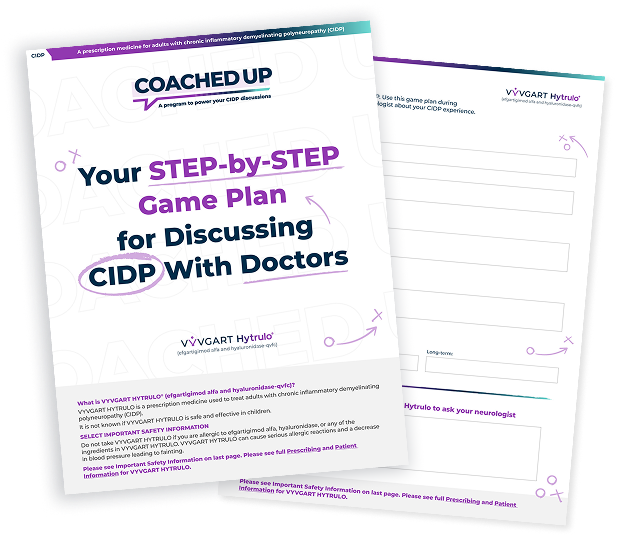
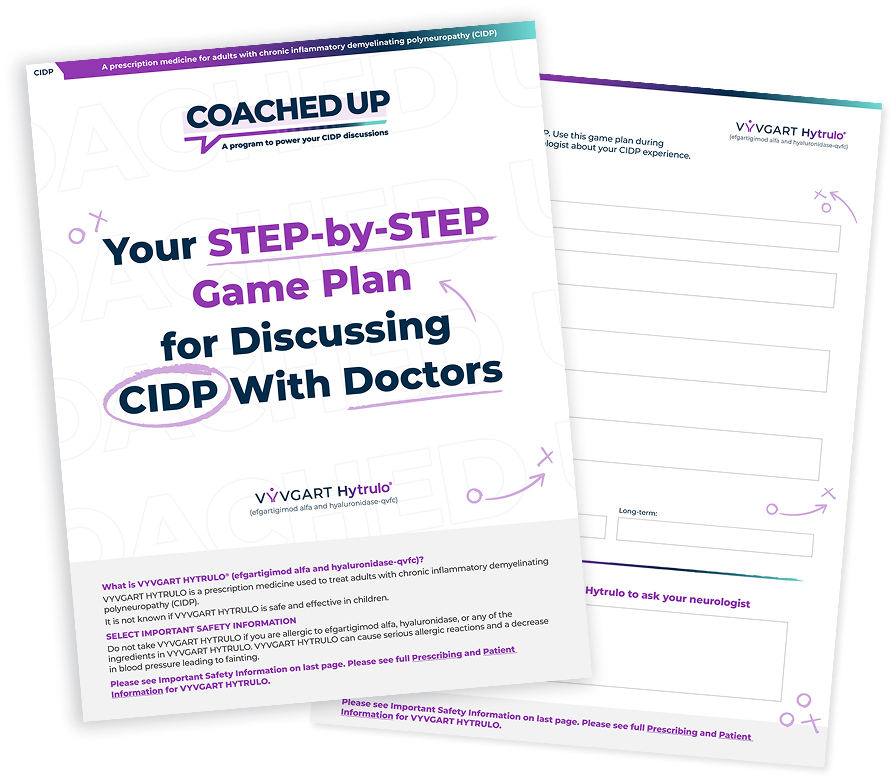
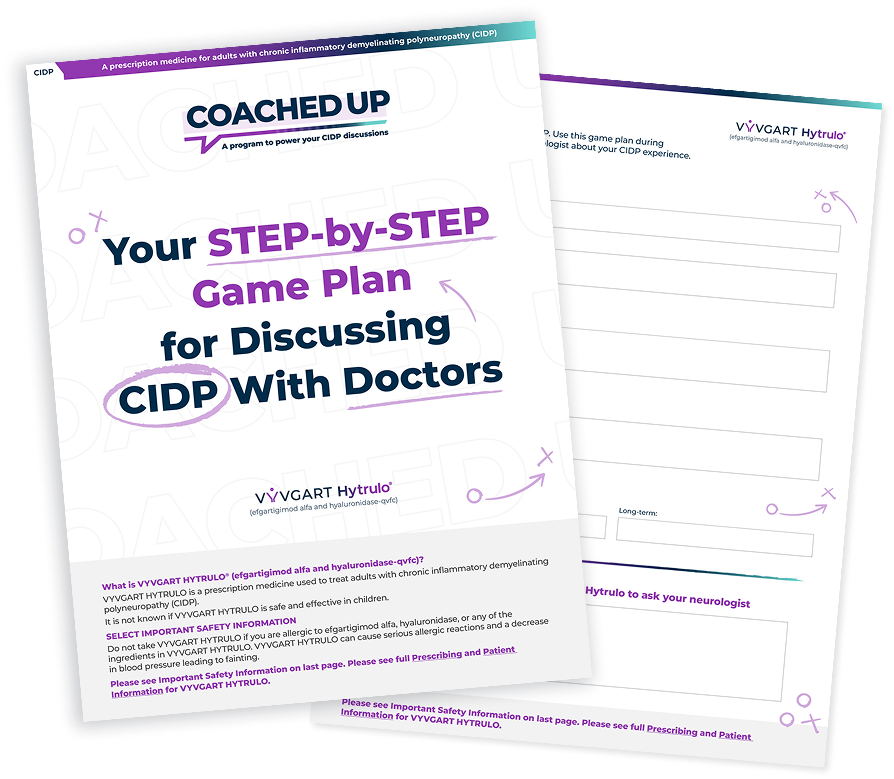

No time to answer these questions?
Download the STEP-by-STEP Doctor Discussion Guide now and bring it to your next appointment to kick off your conversation.


The next STEP in your CIDP journey
When it comes to talking to your neurologist, it can be difficult to know where to start. That’s why Coach Ed and his team have come up with CIDP STEP—a tool to help you focus on what details to cover during your next conversation.






Do not take VYVGART HYTRULO if you are allergic to efgartigimod alfa, hyaluronidase, or any of the ingredients in VYVGART HYTRULO. VYVGART HYTRULO can cause serious allergic reactions and a decrease in blood pressure leading to fainting.
Before taking VYVGART HYTRULO, tell your healthcare provider about all of your medical conditions, including if you:
- have an infection or fever.
- have recently received or are scheduled to receive any vaccinations.
- have any history of allergic reactions.
- have kidney (renal) problems.
- are pregnant or plan to become pregnant. It is not known whether VYVGART HYTRULO will harm your unborn baby.
- Pregnancy Exposure Registry. There is a pregnancy exposure registry for women who use VYVGART HYTRULO during pregnancy. The purpose of this registry is to collect information about your health and your baby. Your healthcare provider can enroll you in this registry. You may also enroll yourself or get more information about the registry by calling 1-855-272-6524 or going to VYVGARTPregnancy.com
- are breastfeeding or plan to breastfeed. It is not known if VYVGART HYTRULO passes into your breast milk.
Tell your healthcare provider about all the medicines you take, including prescription and over-the-counter medicines, vitamins, and herbal supplements.
VYVGART HYTRULO can cause side effects which can be serious, including:
- Infection. VYVGART HYTRULO may increase the risk of infection. If you have an active infection, your healthcare provider should delay your treatment with VYVGART HYTRULO until your infection is gone. Tell your healthcare provider right away if you get any of the following signs and symptoms of an infection:
- fever
- chills
- frequent and painful urination
- cough
- pain and blockage of nasal passages
- wheezing
- shortness of breath
- sore throat
- excess phlegm
- nasal discharge
- Allergic reactions (hypersensitivity reactions). VYVGART HYTRULO can cause allergic reactions that can be severe. These reactions can happen during, shortly after, or weeks after your VYVGART HYTRULO injection. Tell your healthcare provider or get emergency help right away if you have any of the following symptoms of an allergic reaction:
- rash
- swelling of the face, lips, throat, or tongue
- shortness of breath
- hives
- trouble breathing
- low blood pressure
- fainting
- Infusion or injection-related reactions. VYVGART HYTRULO can cause infusion or injection-related reactions. These reactions can happen during or shortly after your VYVGART HYTRULO injection. Tell your healthcare provider if you have any of the following symptoms of an infusion or injection-related reaction:
- high blood pressure
- chills
- shivering
- chest, stomach, or back pain
The most common side effects of VYVGART HYTRULO include respiratory tract infection, headache, urinary tract infection, and injection site reactions.
These are not all the possible side effects of VYVGART HYTRULO. Call your doctor for medical advice about side effects. You may report side effects to FDA at 1-800-FDA-1088.
What is VYVGART HYTRULO® (efgartigimod alfa and hyaluronidase-qvfc)?
VYVGART HYTRULO is a prescription medicine used to treat adults with chronic inflammatory demyelinating polyneuropathy (CIDP).
It is not known if VYVGART HYTRULO is safe and effective in children.
Please see full Prescribing and Patient Information for VYVGART HYTRULO.
Dosage forms and strengths:
VYVGART Hytrulo is available as a single-dose subcutaneous injection containing: 200 mg/mL of efgartigimod alfa and 2,000 U/mL of hyaluronidase per prefilled syringe, or 180 mg/mL of efgartigimod alfa and 2,000 U/mL of hyaluronidase per vial.
IMPORTANT SAFETY INFORMATION
Do not take VYVGART HYTRULO if you are allergic to efgartigimod alfa, hyaluronidase, or any of the ingredients in VYVGART HYTRULO. VYVGART HYTRULO can cause serious allergic reactions and a decrease in blood pressure leading to fainting.
Before taking VYVGART HYTRULO, tell your healthcare provider about all of your medical conditions, including if you:
- have an infection or fever.
- have recently received or are scheduled to receive any vaccinations.
- have any history of allergic reactions.
- have kidney (renal) problems.
- are pregnant or plan to become pregnant. It is not known whether VYVGART HYTRULO will harm your unborn baby.
- Pregnancy Exposure Registry. There is a pregnancy exposure registry for women who use VYVGART HYTRULO during pregnancy. The purpose of this registry is to collect information about your health and your baby. Your healthcare provider can enroll you in this registry. You may also enroll yourself or get more information about the registry by calling 1-855-272-6524 or going to VYVGARTPregnancy.com
- are breastfeeding or plan to breastfeed. It is not known if VYVGART HYTRULO passes into your breast milk.
Tell your healthcare provider about all the medicines you take, including prescription and over-the-counter medicines, vitamins, and herbal supplements.
VYVGART HYTRULO can cause side effects which can be serious, including:
- Infection. VYVGART HYTRULO may increase the risk of infection. If you have an active infection, your healthcare provider should delay your treatment with VYVGART HYTRULO until your infection is gone. Tell your healthcare provider right away if you get any of the following signs and symptoms of an infection:
- fever
- chills
- frequent and painful urination
- cough
- pain and blockage of nasal passages
- wheezing
- shortness of breath
- sore throat
- excess phlegm
- nasal discharge
- Allergic reactions (hypersensitivity reactions). VYVGART HYTRULO can cause allergic reactions that can be severe. These reactions can happen during, shortly after, or weeks after your VYVGART HYTRULO injection. Tell your healthcare provider or get emergency help right away if you have any of the following symptoms of an allergic reaction:
- rash
- swelling of the face, lips, throat, or tongue
- shortness of breath
- hives
- trouble breathing
- low blood pressure
- fainting
- Infusion or injection-related reactions. VYVGART HYTRULO can cause infusion or injection-related reactions. These reactions can happen during or shortly after your VYVGART HYTRULO injection. Tell your healthcare provider if you have any of the following symptoms of an infusion or injection-related reaction:
- high blood pressure
- chills
- shivering
- chest, stomach, or back pain
The most common side effects of VYVGART HYTRULO include respiratory tract infection, headache, urinary tract infection, and injection site reactions.
These are not all the possible side effects of VYVGART HYTRULO. Call your doctor for medical advice about side effects. You may report side effects to FDA at 1-800-FDA-1088.
What is VYVGART HYTRULO® (efgartigimod alfa and hyaluronidase-qvfc)?
VYVGART HYTRULO is a prescription medicine used to treat adults with chronic inflammatory demyelinating polyneuropathy (CIDP).
It is not known if VYVGART HYTRULO is safe and effective in children.
Please see full Prescribing and Patient Information for VYVGART HYTRULO.
Dosage forms and strengths:
VYVGART Hytrulo is available as a single-dose subcutaneous injection containing: 200 mg/mL of efgartigimod alfa and 2,000 U/mL of hyaluronidase per prefilled syringe, or 180 mg/mL of efgartigimod alfa and 2,000 U/mL of hyaluronidase per vial.
 Facebook
 Twitter
 Pinterest
This site is intended for patients and caregivers.
Disclaimer | Privacy Policy | Contact Us |
VYVGART and VYVGART Hytrulo are registered trademarks of argenx.
LIVE VYVIDLY and THAT’S LIVING VYVIDLY are trademarks of argenx.
For U.S. audiences only.
©2026 argenx
US-VYV_HYT-26-00102 V1 11/2026